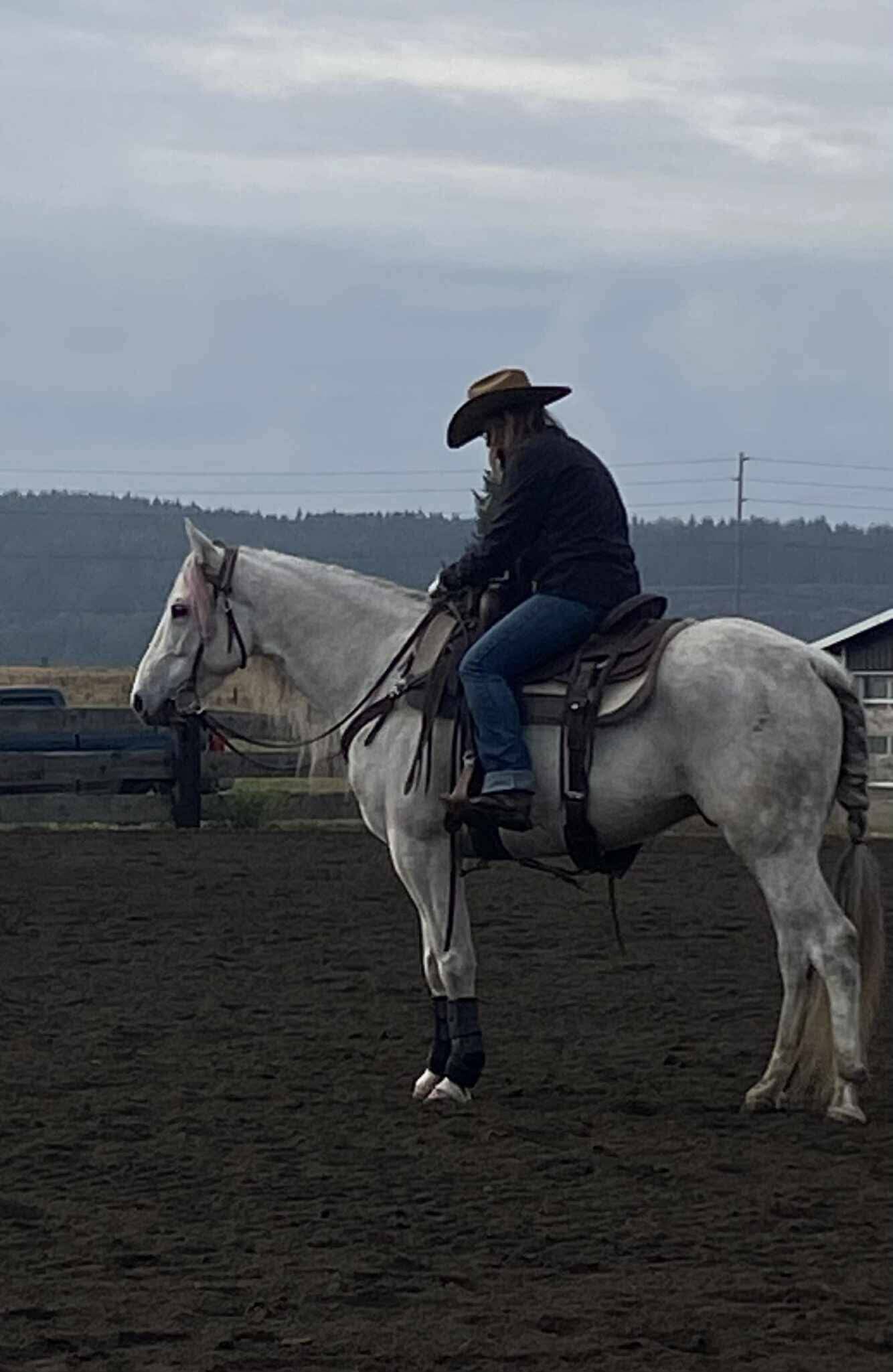
When I was in bodywork school, one of my instructors said something I will never forget. This isn’t a direct quote, but what I remember was something along the lines of this: *the longer you do this work, the more you will notice the ways your insides don’t match your outsides.*
What he meant was that horses notice the discrepancies between how we present ourselves to the world and how we truly are inside.
When I first heard this, I thought I had it pretty well figured out. I had spent several years working with show horses, hauling them all over the country to new and stressful environments, often acting as their anchor in each new place. After that, I worked at a large rescue with horses of all levels of training and background. I felt I had a fairly solid understanding of how to leave a lot of my own “stuff” at the door and show up present and in the moment.
But, as with many things in life, I couldn’t see what I couldn’t see—until horses made it clear to me.
Through my practice, horses have guided me to look even more inward. To look for that quieter light of intuition and understanding. There are times when my hands are on a horse and a technique I’ve used countless times just isn’t connecting. In those moments, looking inward—and usually softening—often brings the connection back.
Early on, when this happened, I would reach for *something*: a technique, a source, a tangible shift in the tissue. What I focus on now is simpler, and much harder to describe: a deeper level of noticing. It’s the act of noticing itself that creates the connection.
When I’m really in that zone of observation, I can feel my feet on the ground, my hands on the horse, and the subtle link between our respiration cycles. I notice when they blink, when an ear flicks back toward me, when the eye softens. When these small details come into focus, I can reflect back to the horse that I see them and adjust (or stay) based on that information.
When I was first beginning my practice, I traced the Masterson Method bladder meridian on just about every horse I could get my hands on. I still highly recommend this as a way to connect with your horse. The premise is simple: run your fingers, as lightly as needed, down the bladder meridian (essentially the horse’s topline) and watch for a blink. When you see a response, you pause and observe.
This information can be found in Jim Masterson’s books or on his YouTube channel. This action (or perhaps more accurately, *non-action*) of waiting for your horse often yields incredibly interesting responses. Do this enough times and you begin to build a constellation of data points that can reveal patterns.
This daily practice of noticing small details in the horses I work with has also illuminated the subtle ways I need to improve my own alignment. (P.S. *Alignment* is one of my words for 2026.) It has made me a better horse owner, trainer, and rider, and it has become a cornerstone of my bodywork practice.
I’ve made many changes in my personal life over the past three years, largely because of the horses. If I’m putting so much effort into noticing their reactions, why wouldn’t I do the same for my own body—even outside of time spent with my hands on horses? When that quiet, persistent feeling arises that I *should* do something to care for myself or improve my life, I’ve started listening.
In my horsemanship, I’ve made a conscious shift toward riding for comfort and soundness, allowing competition to take a secondary seat. (Still a close secondary seat—but secondary nonetheless.)
Another exercise I love for inviting the horse to notice us, and showing them that we notice them, is simple: pick a spot on their neck and gently scratch. When the ear on that side flicks back toward you, stop scratching. That pause acknowledges the ear flick. It says, *I saw that.*
I’ll do this both on the ground and in the saddle. It can be especially helpful in moments when things start to feel a little sideways—you know those moments when a horse is in freeze and you can feel their heartbeat through their skin. If it’s safe, I’ll often try this before redirecting. This wasn’t my original idea; it’s my version of something I remember Warwick Schiller talking about on his podcast.
Over time, I’ve noticed where self-doubt has held me back from trying new things. I’ve felt how that doubt makes me less capable of noticing what’s happening in the moment, both inside and outside of my practice. When I’m focused on what others might see, think, or feel, I often miss those tiny ear flicks or soft wrinkles around the eyes.
Horses know when I try to cover up that doubt. That’s one reason I believe it’s so important, as equine professionals, to be able to say, “I don’t know, but I’ll try to find out.” For me, research, science, and continued education help immensely with self-doubt. Knowledge is empowering, and horses appreciate clarity and intention.
When my insides match my outsides, I can feel the air on my skin, my hand on the horse, and still hear the owner speaking. I can see the ear flicks, the nostril flares, the small changes in the eye. I can speak from a place of certainty—or admit that I don’t know.
And in those moments, I feel like I can truly see.
Where might your horsemanship shift if your internal state and external actions were more closely aligned?